


SOUTH SALT LAKE – Parker Theatre has a track record of solid, engaging productions, and Cyrano De Bergerac, is no exception. Adapted from the 1897 play by Edmond Rostand, and directed by Artistic Director, Spencer Hohl, it is the story of Cyrano, a gifted poet, who falls in love with the beautiful Roxane, but refuses to tell her because he believes his physical appearance, namely his extremely large nose, would prevent her from loving him. Instead, he helps another man woo her using his words. The text deals with personal insecurities, the nature of love and the worth of a soul.
The restored Parker Theatre is always a treat. If you’ve never been, it is well worth the trip, just to sit in and enjoy the beautiful art deco restoration. The yellow velvet grand curtain is a stunning centerpiece that is often used as a backdrop for projections and lighting treatments. We see a lot of this curtain in this production. The preshow announcement warns us that the curtain will be drawn between acts, but that there is only one full intermission. More on this in a bit.
Hohl’s director’s note describes the adaptation he created and used for this production. Written in rhyming French couplets, the original version presents a translation challenge and runs long. Hohl notes that his adaptation aims to“create a version that feels more accessible while preserving the heart, humor and beauty of Rostand’s original work.” The adaptation is indeed funny, accessible but remains substantial coming in a little under three hours.
The theatre uses a traveler system where panels and scenery are hung from horizontal rails and slide on and off stage, creating depth, defined space, and curated focal points. The set is beautifully designed by James B. Parker to look like wood paneled walls. At the center back of the space are two large, functional doors, painted to look like iron. Some panels are topped with lovely Fleur-de-lis lattice and some with arches evocative of stained glass windows. The stenciled parquet-like lattice down the center of the stage floor is similarly lovely. However, flanking this stenciling is black ladder-like striping which I found distracting and conflicting with the rest of the design. Despite this minor inconsistency, the set design creates a warmth that invites the audience into the world of the play.
As the opening scene is setting up a performance within the play, it is fitting that some entrances are made from the audience. In particular, and to great effect, Cyrano’s entrance begins from the back of the house, in darkness, as he heckles the performer on stage. When Roger Dunbar as Cyrano enters into the light, his prosthetic nose is mesmerizing. Make-up is credited to Helene Parker, who outdid herself on the nose. The appendage is scripted as distractingly large, and it is indeed. Extending perhaps 4 inches from Dunbar’s face, I found myself worrying throughout the production that it might get caught or whacked in some way and wrenched off. Fortunately, that didn’t happen, but there are times when the intensity of Dunbar’s acting causes it to tremor in a way that belies it being made of something rubbery rather than cartilage. In some ways it works well given the textual reference to how astonishing the nose is, and how impossible it is not to stare at. At the same time, and for the same reasons it is often distracting. Going a bit smaller might have solved this, but it is an unapologetic choice for such an iconic element of this play.
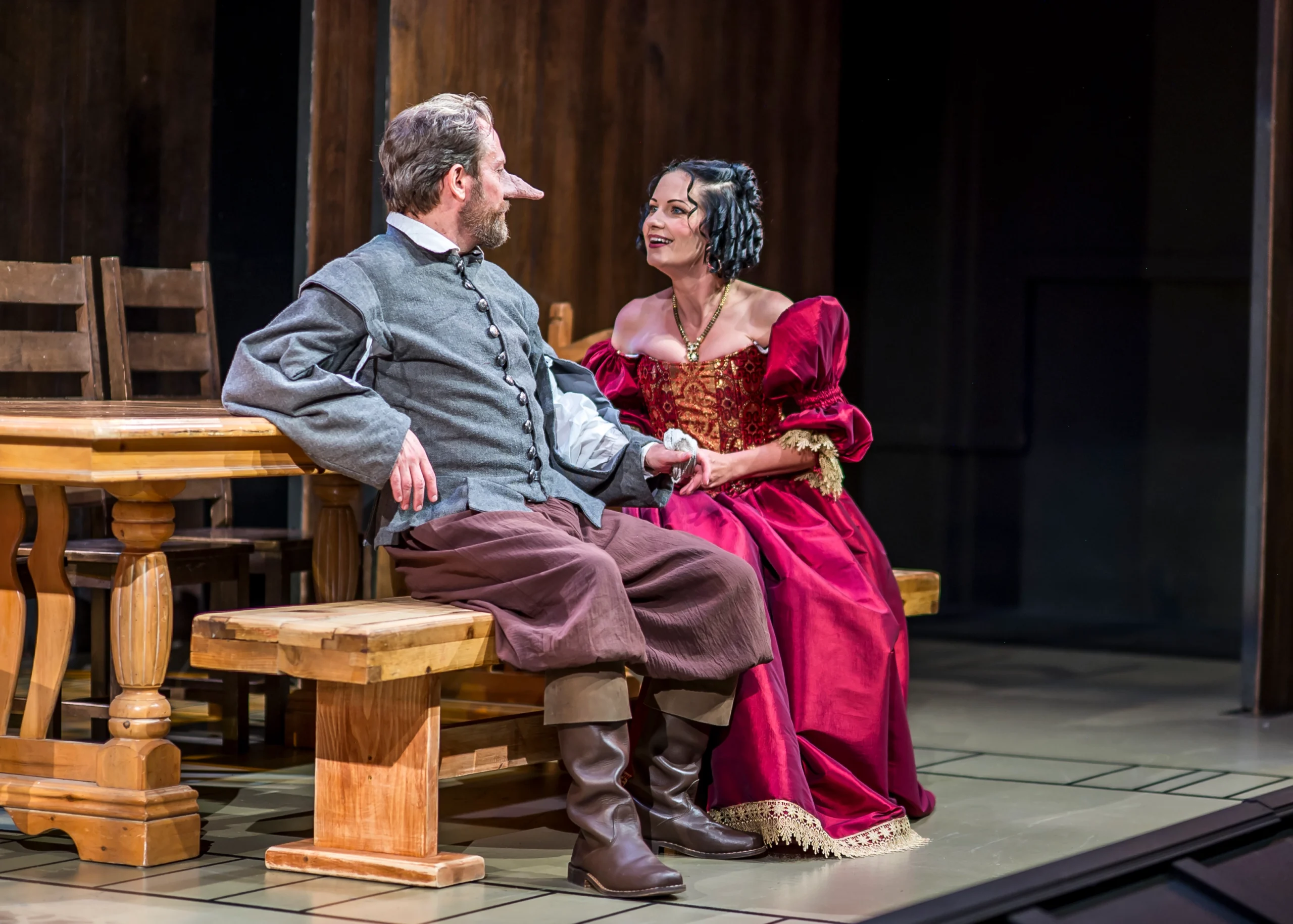
The pacing and delivery in the first act is a bit off and the vocal projection by most of the cast, and even, surprisingly, Dunbar is lacking, such that some of the witty repartee and nose-jokes fall a little flat. This felt like a bit of opening day jitters, and lack of polish that will hopefully work itself out as the run continues. The fight choreography, also by Hohl, is outstanding. The initial fight between Dunbar’s Cyrano and Anton Moss’s Vicomte De Valvert is excellent. Moss’s combat experience shines. The combat throughout the production is superb.
The cast is skilled. Dunbar is a local favorite, and for good reason. By Act 2, he seems to overcome the shortcomings of the opening, and his skill as an actor is clear as he handles the mix of bravado and insecurity within Cyrano with convincing generosity. Kristi Curtis as Roxane is also skilled, conveying the passion and complexity of her character capably. Russ Maxfield as Christian is well-cast, both for his good looks, and his ability to play the tongue-tied foil to Cyrano’s poetic brilliance. The skilled comic timing of these three is unequivocal in the balcony scene in Act 3. The rest of the cast works well together with particular stand-outs in Robert Easton as a hilarious Montfleury, and Jacob Shamy as a sincere Le Bret.
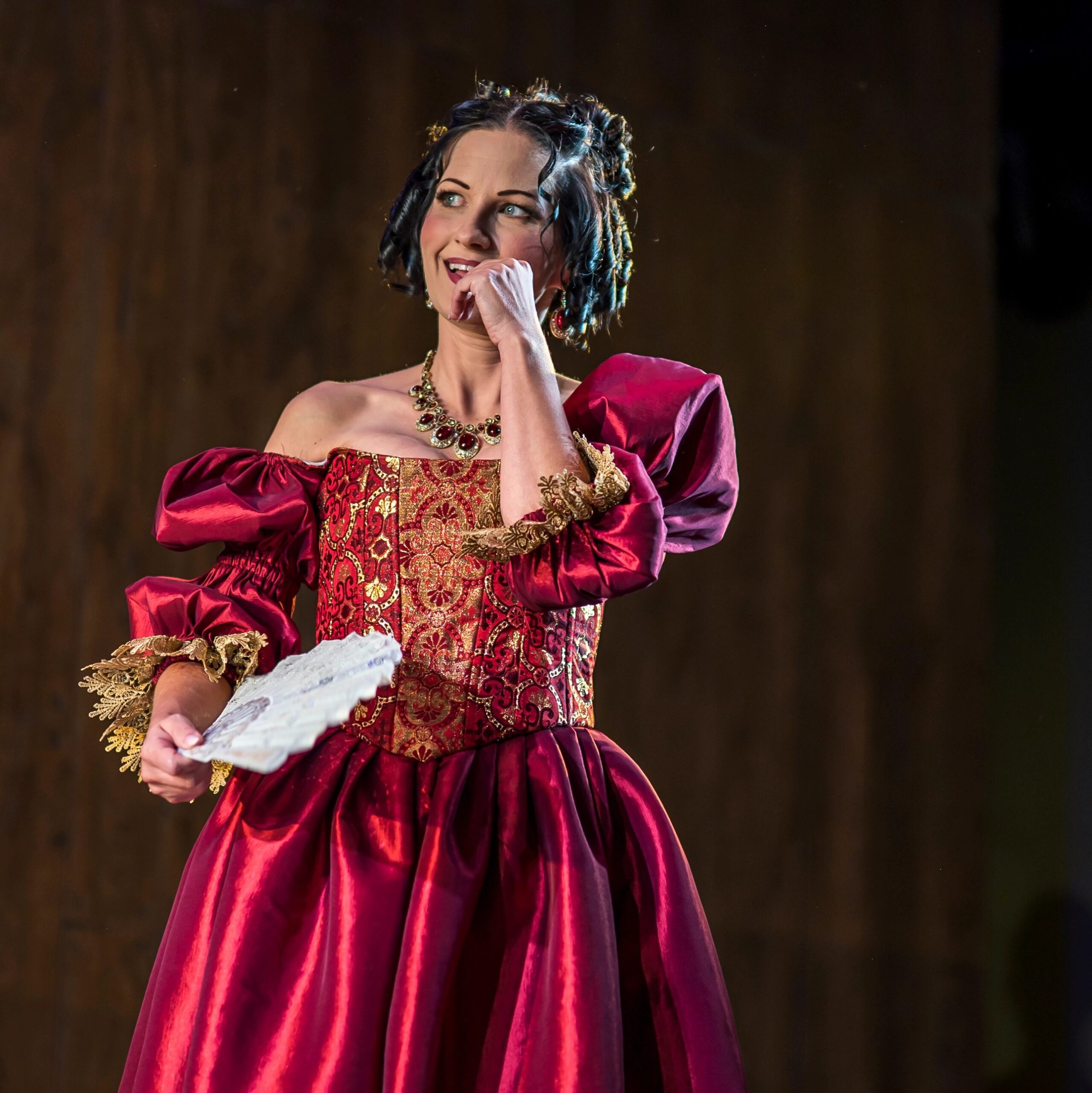
Costume design by Rebecca Fenton is also adept. Rich brocades, puffy pants and floppy boots fill the stage and evoke the period. Curtis, in Roxane’s red gown is stunning, as is the beautiful brocade vest sported by Russ Maxfield as Christian.

The lighting, also by James B. Parker, is effective. The side washes setting mood, time and place. The use of projection contributes positively to the production, especially when trees and rain are projected during the battle scenes. A missed opportunity exists in the final act where the text clearly denotes the place is outside. However the stark chandeliers, arched doorways, and wood paneling denote an indoor setting. Simply adding tree projections or other outdoor indicators during this scene would greatly enhance it, and better support the text.
A scenic element worth further mention is the use of full grand drape closures during lengthy scene changes between acts. Although this is likely a nod to the historic convention of the period, and despite my love for Parker’s beautiful yellow curtain, it detracts from the production. Modern audiences are accustomed to watching scene changes, and closing the drape for an extended transition serves only to pull the audience out of the illusion of the play. This production briefly uses a lovely sheer scrim at the beginning of each act, upon which is projected the act title. I wished there had been greater use of this scrim–perhaps seeing choreographed scene changes in low light, through the scrim would maintain audience focus and interest, while maintaining a nod to the closed curtain changes of the period. This felt like real a lost opportunity and pulls the audience completely out of the world of the play each time it occurs.
Nonetheless, this is a minor distraction in the overall production, but something that left me wishing it was better managed, because the production is so lovely. In typical Parker style it is beautiful, thoughtful, well-directed, well-designed and well-performed and is certainly well-worth attending.
MORE INFO: CYRANO DE BERGERAC is currently playing at Parker Theatre (3605 South State Street, South Salt Lake, UT 84115) as part of the theatre’s 2026 Mainstage season. Performances are held at 7:30 PM on Fridays and Saturdays, with 3:30 PM Saturday matinees, through August 29, 2026. Tickets are $23 for children (17 and under) and $32 for adults. For the most up-to-date schedule, performance details, and official ticketing, visit the Parker Theatre website
FOLLOW US ON FACEBOOK, INSTAGRAM, and TIKTOK!
If you’re a director, producer or marketing contact who would like to have us review your show, please fill out this form.
If you have comments about this article, please fill out this form.