

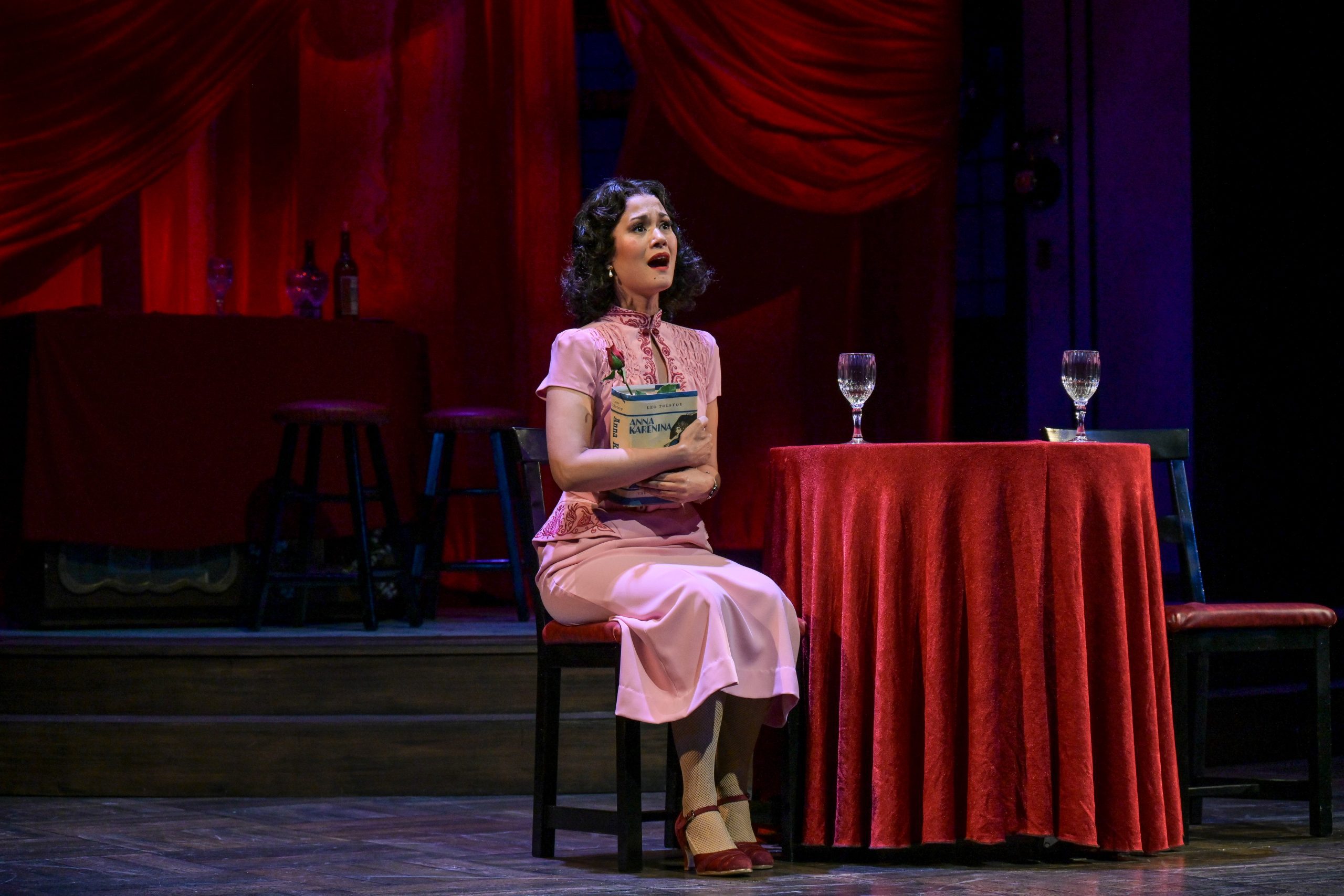
CEDAR CITY — As the Utah Shakespeare Festival celebrates its 65th anniversary in Cedar City, its production of She Loves Me reminds audiences why this romantic musical has endured for more than six decades. Based on Hungarian playwright Miklós László‘s 1937 play Parfumerie, the musical also inspired such beloved films as The Shop Around the Corner, In the Good Old Summertime, and You’ve Got Mail. Though each adaptation differs in setting and style, the central story remains timeless: two coworkers who spar in person unknowingly fall in love as anonymous pen pals.
Set in a 1930s Budapest perfume shop, She Loves Me has a book by Joe Masteroff, music by Jerry Bock, and lyrics by Sheldon Harnick. It follows Georg Nowack and Amalia Balash, clerks whose workplace friction contrasts sharply with the tenderness they express in letters to an unknown correspondent. As romance, misunderstandings, and workplace intrigue unfold among the shop’s employees, audiences eagerly await the moment when the pair discover they have been writing to one another all along.
Directed by Michael Perlman, the production embraces the musical’s warmth and optimism. In an era that often favors irony over sincerity, She Loves Me offers something increasingly rare: a hopeful love story that celebrates kindness, grace, and the possibility that extraordinary relationships can grow from ordinary lives.
Jo Winiarski‘s scenic design is both functional and visually engaging. She employs a revolving stage – only the second time in the Randall L. Jones theater’s history, according to the Festival’s pre-show play orientation in the Seminar Grove. The turntable gracefully moves audiences between the streets of Budapest and the interior of Maraczek’s Parfumerie, maintaining momentum while reinforcing the lively rhythm of the shop.
Jen Gillette‘s costumes beautifully evoke the period while distinguishing each character through subtle visual cues that reflect age, personality, and social standing. Leigh Scheffler‘s choreography likewise serves the storytelling with imaginative ensemble movement that captures the bustling Budapest while weaving in touches of Hungarian folk dance. A playful nod to the iconic choreography in the song “Singin’ in the Rain” from that film provides a delightful Easter egg for musical theater lovers.
Music director Brad Carroll delivers a polished production, though the decision to use recorded orchestrations instead of a live orchestra may divide audiences. The accompaniment is expertly produced, but some theatergoers may miss the spontaneity and richness that a live pit orchestra brings to a professional musical.

Ali Ewoldt brings a rich, expressive soprano to the role of Amalia Balash. Her singing captures the warmth and lyricism of Jerry Bock’s score, particularly in the character’s soaring melodic lines. Dramatically, however, the portrayal sometimes feels at odds with the music. Amalia is presented with near-constant nervous energy, her dialogue and physicality often bordering on frantic. While the performance is fully committed, the anxious characterization occasionally obscures the gentleness and quiet romanticism suggested by the score.
Matt Koenig’s Georg Nowack offers an equally appealing vocal performance, communicating the character’s emotional journey with sincerity and ease. Yet the central relationship between Georg and Amalia doesn’t fully establish the source of their mutual antagonism. Their early conflict seems driven more by generalized anxiousness than by clearly defined differences in personality or purpose. Consequently, first-time viewers may struggle to understand why the pair remain at odds for so long, making their eventual reconciliation feel somewhat less emotionally satisfying than the musical intends.
Among the supporting cast, Meggie Siegrist is a standout as Ilona Ritter. With a lovely voice and precision comic timing, she avoids reducing Ilona to a stock ingénue. Instead, she creates a woman of confidence, wit, and purpose whose eventual happiness feels fully earned. Siegrist’s vibrant performance illuminates the thinking woman’s pursuit, and the audience cannot help but root for her success.
Pascal Pastrana is equally effective as Steven Kodaly, the charming philanderer whose behavior creates much of the show’s conflict. He strikes an ideal balance between charisma and sleaze – just likable enough to understand his appeal and just objectionable enough that audiences are relieved when he departs. Pastrana skillfully uncovers both the humor and the underlying unpleasantness of the role.
One recurring challenge throughout the evening was the pace of the dialogue. Important exchanges frequently moved so quickly that portions became difficult to understand. Audience members seated behind me repeatedly asked one another what had just been said, and I often found myself asking the same question. Several moments passed when the audience didn’t have sufficient opportunity to absorb key lines.
Even with these shortcomings, She Loves Me remains an irresistibly charming musical. Its enduring appeal lies not in elaborate spectacle but in its genuine affection for ordinary people searching for connection. The Utah Shakespeare Festival’s anniversary production captures that essential innocence with affection, humor, and visual elegance. Audiences leave the theatre reminded that hope and unexpected love still make for compelling storytelling – a welcome antidote to modern cynicism and a fitting celebration for one of America’s premier regional theatre festivals.
MORE INFO: SHE LOVES ME plays at the Utah Shakespeare Festival until October 3rd in the Randall L. Jones Theatre, (195 W Center St
Cedar City, UT 84720). Ticket prices range from $41-$96. For more information or to buy tickets, please visit their website here or call 800-PLAYTIX (752-9849).
FOLLOW US ON FACEBOOK, INSTAGRAM, and TIKTOK!
If you’re a director, producer or marketing contact who would like to have us review your show, please fill out this form.
If you have comments about this article, please fill out this form.