


SALT LAKE CITY—Pygmalion’s production of Jen Silverman’s Witch casts a compelling charm and aligns with the company’s focus on women’s stories and voices. I’ve enjoyed everything I’ve seen this company produce and Witch is my new favorite. Playing in the Leona Wagner Black Box Theatre at the Rose Wagner Performing Arts Center and directed by the talented Morag Shepherd, there is so much to love about this quirky, inventive, and thought-provoking production.
Witch is adapted from The Witch of Edmonton, a morality play written in 1621 Jacobean England about sinners being appropriately punished, and is based on the historical witch trial and execution of Elizabeth Sawyer. Jen Silverman’s adaptation shares very little with the original, beyond the character names and some very basic plot elements. Silverman’s script turns a moralistic tragicomedy into a slightly absurdist, anachronistic modern dark comedy with themes of societal isolation, agency, ambition, and hopelessness. Morag Shepherd and the company turns it into a delectably fun evening.
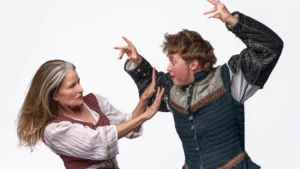
In Witch, Elizabeth, played by Stephanie Howell, is a societal outcast, falsely assumed to be a witch and marginalized by her village. Cuddy, played by Amona Faatua, and Frank, played by Pedro Flores, vie for wealth, status, love, and revenge. Scratch, played by McKell Rae, arrives to entice each to trade their soul for their deepest desires, and all but Elizabeth readily do so. Intrigued by her denial of his offer, Scratch continues to visit Elizabeth to persuade her, and the two develop a deep and unexpected connection. Much mayhem and intrigue ensues, and both Elizabeth and Scratch are left to contemplate the nature of existence, the worth of a soul, the illusion of choice, and the means of human transformation.
Silverman’s script sets the production in 1621 but expressly notes that the language and interactions should be contemporary. Shepherd, as both director and sound designer, with Allen Smith as set designer, make this clear right out of the gate, juxtaposing contemporary pre-show music with a distinctly Jacobean-inspired set. Entering the space, while Billie Eilish sings “Bad Guy” in the background, I was met by a solid, yet airy set, floating in the black box space, heavy box beams protruding from a plastered wall center stage over a large wooden table and chairs. An awkwardly large painted portrait of a woman hangs on one side of the wall while a dying brown vine of some sort snakes up the other side. The set is flanked by rectangular arbors made by the same box beams, from which are hung dried herbs and braids of garlic. There is space between the wall and the arbors, creating a flexible playing area with undefined doorways, allowing characters to enter between, through, and around these set pieces, without needing to define one playing area as a specific place within the village. Various small tables are crammed with paraphernalia for preparing herbal concoctions such as a large mortar and pestle, candles, bottles, and bowls. Shepherd’s music and (sometimes strange) industrial sound choices underpin and support the production. The show begins with rather heavy underscoring of music and sound, which hovers on the edge of distraction at first, but then becomes punchy and wholly appropriate to support key moments throughout the production.
Lighting by Savanna Garlick plays an important role in this production. The first lights up finds Howell dancing with abandon to the modern music, donned in peasant garb. Suddenly lights black out and momentarily return, illuminating Howell, now frozen in tableau with Rae hovering alarmingly over her shoulder. Black out again, followed by lights up and the show proceeds. This blackout-red light tableau-blackout-resumption pattern follows throughout the entire production with expert execution and to great effect.
Shepherd uses these freeze-cut tableaus—the most striking theatrical element of this production—to advance the story, express inner thoughts and desires, and to add humor. From Rae’s evocative soul-claiming freezes, to sometimes desire—and sometimes memory—induced tableaus, and ultimately a brief but riotous dance sequence within a tableau, these moments are often funny, sometimes disturbing, and always thought provoking. Often they seem intentionally confusing as well, sometimes more clarity follows later, and sometimes not at all, but they are somehow always exactly what is needed. This is the sort of innovative convention at which Shepherd excels.

Shepherd’s staging is creative and effective, both in the tableaus and in keeping dialogue and scene flow interesting and moving. Shepherd has an eye for balance, intentional imbalance, comedy, and visual impact. For example, when Winifred, played by Juls Marino, moves in and out of the scene at appropriate and inappropriate moments. At one point, she enters with a single large sweet potato alone on a platter, with no explanation and no purpose, squeezing awkwardly behind and through the scene play at hand, only to exit on the other side. This sort of delightfully absurd touch felt a bit like the gorilla basketball challenge and left me wondering what else I might have missed entirely while my attention was elsewhere. The fight scene between Faatua and Flores, with excellent fight choreography by A.J. Neushwander, is also captivating in its balance between physical intimacy and brutality, ending in an intensely absurd and emotion-packed Morris dance by Faatua over Flores’s lifeless body, that was equal parts disturbing and fascinating.
Silverman’s script is delightful. The contemporary dialogue is quick, witty, and that much more funny for its anachronism. Beyond dialogue, Silverman has a clear knack for monologue. Sir Arthur’s outstanding “update from the field,” wherein he monologues with the portrait of his departed wife, is full of delectable comedy and poignant vulnerability. Barrett Ogden plays Sir Arthur with abandon and gusto—tempered with heartrending openness—and is truly delightful. Likewise, Rae’s delivery of the final monologue is numinous. Rae’s existential crisis and inability to find hope is terribly relatable.

Mckell Rae as Scratch really comes into their own in this production. Having seen their work in other pieces—solid for a young actor—this role blew me away. Rae’s comic timing and intelligent delivery is captivating—especially in moments like the “blood tsunami” monologue delivered from the audience. Their vulnerability both in the developing relationship with Elizabeth and, in particular, the final monologue as they capture so perfectly what many of us are feeling—“I find it really hard to have hope right now”—cuts deep.
The entire cast is outstanding. Howell’s Elizabeth has a sincere depth, is compelling, and develops compelling chemistry with Rae. Faatau and Flores likewise create an unexpected chemistry and deliver solid performances. Marino’s development of Winnifred is apt, exuding confidence in delivery and comedy.
If you’re only familiar with the larger theatres in the area, I highly recommend branching out to productions at the Rose—Witch is a great introductory show. I have never been disappointed in a Pygmalion production. The company and space is a good in-between for those not ready to branch out into the underbelly of gritty grassroots theatre, but want something more than the same old offerings elsewhere—something a bit different, compelling, and thought-provoking. Witch is all that and more.
MORE INFO: WITCH is currently playing at the Rose Wagner Performing Arts Center (138 W Broadway, Salt Lake City, UT 84101). Performances are held at 7:30 PM Thursday through Saturday, with Sunday shows at 4:00 PM, through October 17. Tickets for Witch range from $24-$29. For the most up-to-date schedule, performance details, and official ticketing, visit https://pygmalionproductions.org/
FOLLOW US ON FACEBOOK and INSTAGRAM and TIKTOK!
If you’re a director, producer or marketing contact who would like to have us review your show, please fill out this form.
If you have comments about this article, please fill out this form.