

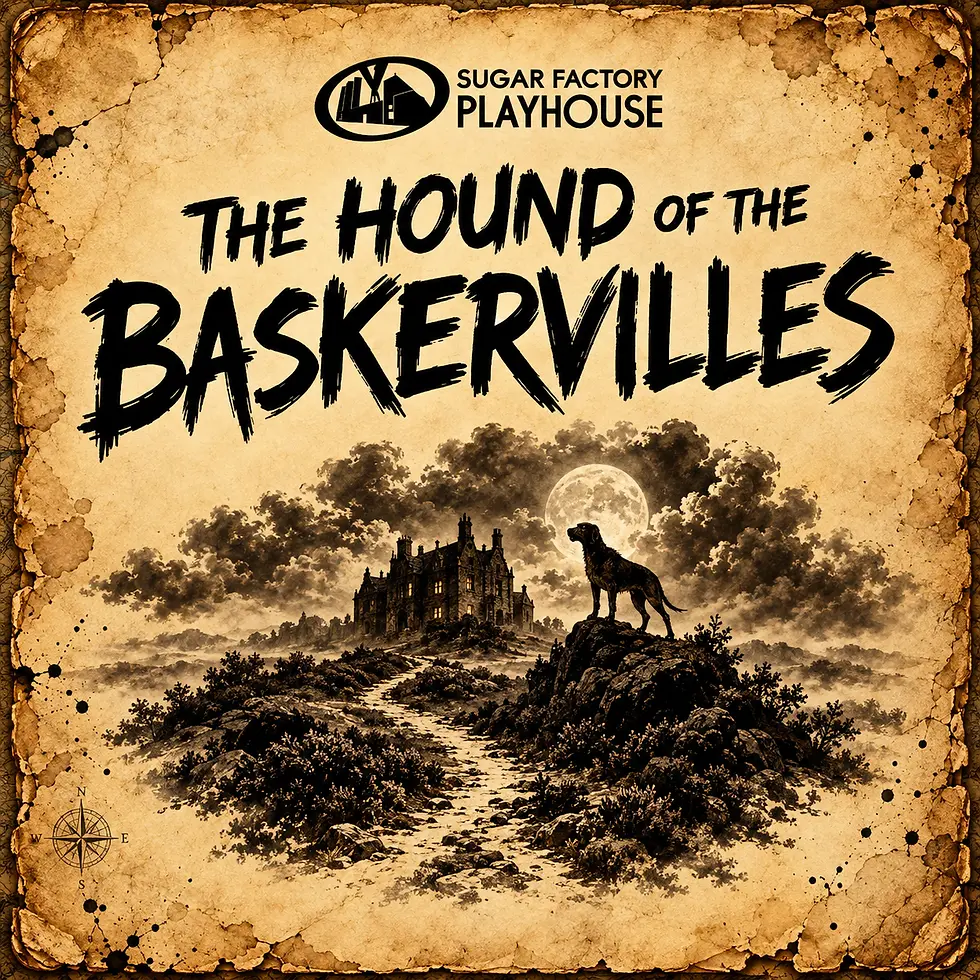
WEST JORDAN — Presented by Sugar Factory Playhouse at the Canyon View Credit Union Community & Arts Center, The Hound of the Baskervilles is a delightful mystery, perfectly positioned to welcome the season. I am always thrilled to find new-to-me theatre venues in this area but discovering this space is particularly exciting as a west-sider myself, where there just aren’t as many venues as other areas in the valley. The beautiful new venue is located just behind the Gene Fullmer Recreation Center and West Jordan Library. The company, Sugar Factory Playhouse, began producing shows in West Jordan nearly 30 years ago with first shows taking place in a local park before eventually moving into the old sugar factory building. When that building was closed and eventually razed for safety concerns, the company was homeless for a bit, performing at different venues in the area until the new community space was complete. The preshow announcement listed off all the other community organizations using the venue—it is a great resource for the West Jordan community.
Production Photos have not yet been received by UTAJ. When they are, they will be added to this review.
The Hound of the Baskervilles is an adaptation by Tim Kelly of Sir Arthur Conan Doyle’s story, and as expected, involves the infamous Sherlock Holmes, Dr. Watson, and a mysterious and murderous hound. The detective and the doctor are summoned to an isolated estate in the desolate Dartmoor countryside, several hours train ride west of London, to investigate the death by mauling of Sir Charles Baskerville. Sightings and sounds of a great hound with glowing red eyes create a supernatural mystery to be solved. All the residents of the large estate become suspects as Holmes and Watson ascertain the true story. Director Dave Hanson’s program note describes his love for mystery, gothic tales, and horror, as well as Hitchcock-esque suspense. And although the play has some horror undertones, it is more akin to a good mystery-thriller piece than true horror. Hanson sets the show in the 1960s, a nod to Hitchcock that works well. His direction is clean, clear, and natural. The pacing is excellent; it doesn’t drag and comes in at about 90 minutes—a respectable length for a suspenseful evening out.
The canted box set by Michelle Groves, representing the Baskerville Hall, is deliciously detailed. The more I looked, the more I saw. From leatherbound books to carved elephants (a nod to Lord Baskerville’s time in Africa)—each detail was exquisite and apropos. The glass-paneled French doors stage left, leading to the moor, balanced with the front hall and stairs glimpsed through an archway stage right, set the stage nicely. There is a large projection screen up center stage, above the set’s back walls, where images of the moor are projected throughout the show. At first, I wondered if this was strictly necessary—couldn’t we imagine the moor? But as the show progresses, segments of the walls of the set are removed, revealing more of the moor projection, more of the front hall and stairway, and more of the boardwalk off through the French doors. These removals come at scene breaks and at first I found them a bit awkward and confusing. It does become apparent as the show progresses that the moor is metaphorically encroaching upon the manor, with its dank mystery—it made me wish for a bit of stage fog to bring the oft-mentioned moor mists into the manor as well. These scene adjustments are made while other business takes place in a low blue light, so they aren’t overly obtrusive, but without the ability to quickly and smoothly remove these elements (such as a fly system or similar) they are left to be hoisted manually by the stage crew, creating a visually awkward and stuttering shift rather than a smooth transition of disappearing panels. Once they’d been removed, I found the look of the encroaching moor permeating through the missing pieces quite captivating and wished that the show had simply started with them missing entirely, creating a more abstract feel from the outset.
The cast is excellent. Especially Nick Mathews as Sherlock Holmes and Kristi Curtis as Kathy Stapleton. Matthews captures the eccentricity and exuberance of the iconic character deftly. Curtis’s energetic Kathy is captivating. Stu Mitchel as Watson, Tatiana Christensen as Lady Agatha, and Riley Groves as Sir Henry also deliver strong performances and create a cohesive ensemble. The cast makes a respectable attempt at a range of dialects in this production, with Christensen and Mathews in particular excelling in the endeavor. As with most community theater, there is a range of acting experience in the cast but they work well together and even the less experienced cast members hold their own. In particular, Becca Catmull as Perkins has good comic timing, adding much needed lighter moments throughout the production.
Paige Wilson’s costumes are apt and evocative of the period, especially in the dresses sported by Jenna Foulks as Laura Lyons and in the slim-cut suit worn by Mathews. Although I did find myself wishing for a cloak, a cap, or something to give a slight a nod to the iconic image of Sherlock Holmes. A black and white houndstooth cape worn by Christensen felt very appropriate to Lady Agatha’s character, with a nod to the Hound itself.
Sound design by Emilia Hedlund-Drumm contributed thunderings and pattering rain, adding to both the coziness and suspense of the piece. There were some issues with the lavalier mics throughout the production—especially Curtis’s. Honestly, I was surprised to see mics at all in this small space. Curtis has such a strong voice that the mic really isn’t needed, especially in this space. None of this cast seems to need them as they all seem appear capable of projecting sufficiently to reach the back row, and the mics seem to cause more problems than they solve.
Lighting by Robbie Dalley is effective. The show starts in a mysterious blue light, which is used repeatedly throughout—particularly in the scene change moments mentioned previously. The blue lighting is a nice touch at the climax where the mystery is solved. However, the blue lowlight continues through the dénouement to the end of the show, where it feels excessive and makes it difficult to see. The glowing red eyes of the hound was also a nice touch, except placement off stage to the far sides means they aren’t visible by large swaths of the audience. Sitting towards the center of the house will afford greater views of both sides of the stage.
Truly The Hound of the Baskervilles is an excellent community theater production in a lovely venue. It’s clear a lot of love, talent, and dedication have been poured into the show and I highly recommend catching it before its short run is over.
MORE INFO: The Hound of the Baskervilles is currently playing in the Canyon View Credit Union Community & Arts Center in West Jordan, (8105 2200 W, West Jordan, UT 84088, USA). Performances are held at 7:30 PM daily through September 26, 2026. Tickets typically range from $12 to $15. For the most up-to-date schedule, performance details, and official ticketing, visit The Cultural Arts Society of West Jordan website: https://www.wjarts.org/
FOLLOW US ON FACEBOOK, INSTAGRAM, and TIKTOK!
If you’re a director, producer or marketing contact who would like to have us review your show, please fill out this form.
If you have comments about this article, please fill out this form.