

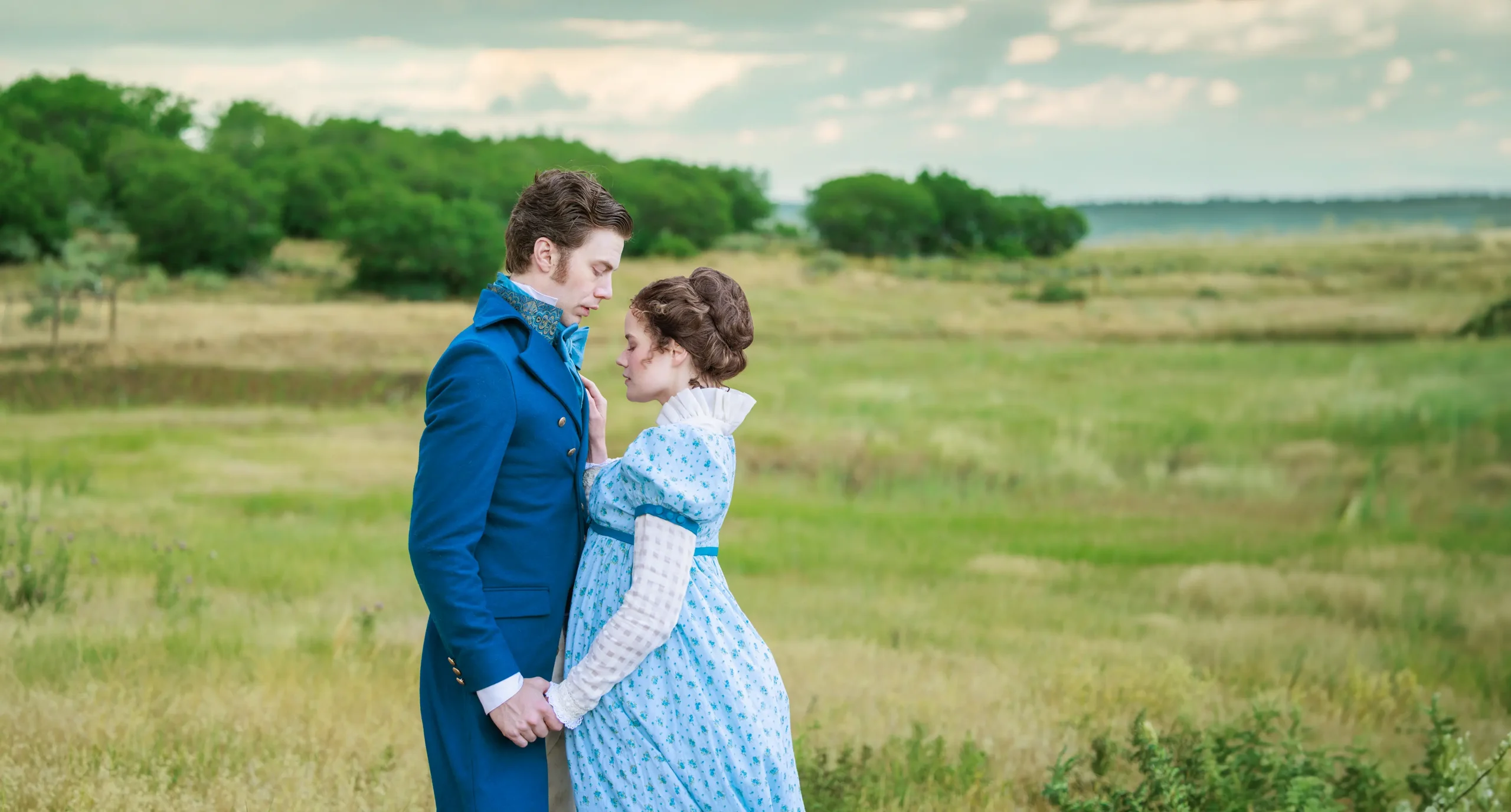
PLEASANT GROVE — The production of Jane Austen’s Pride and Prejudice adapted for the stage by Melissa Leilani Larson at The Ruth and Nathan Hale Theater offers a marvelous and deeply moving theatrical experience. Directed by Kymberly Mellen, the staging brings out the richness of Austen’s world by celebrating the wide spectrum of humanity and individual idiosyncrasies. Rather than relying on flat stereotypes or worn-out tropes, each character is granted distinct and authentic traits while remaining entertaining. Mellen’s clear vision invites the audience to look past preconceived notions. It is an extraordinary, layered success in approaching classic material with grace, warmth, and innovation.
The most stunning innovation is the portrayal of Mrs. Bennet by Anne Post Fife. Traditionally depicted as an exaggerated matriarch opposing Elizabeth’s wishes, Mrs. Bennet is presented here as deaf. Her daughters—Kitty, Mary, Lydia, and Jane—serve as her voice as ASL interpretor. Notably, Elizabeth and Mr. Bennet never act as her voice, emphasizing a flaw of Elizabeth’s connection to her mother versus Mr. Bennet. It allows for Kitty and Mary who most frequently interpret for their mother to react emotionally as they voice. Emily Faith Thurman (Kitty) and Marie Jacobs Aro (Mary) are excellent as their vocalized interpretations offer each sister characterization in how they deliver the dialogue.
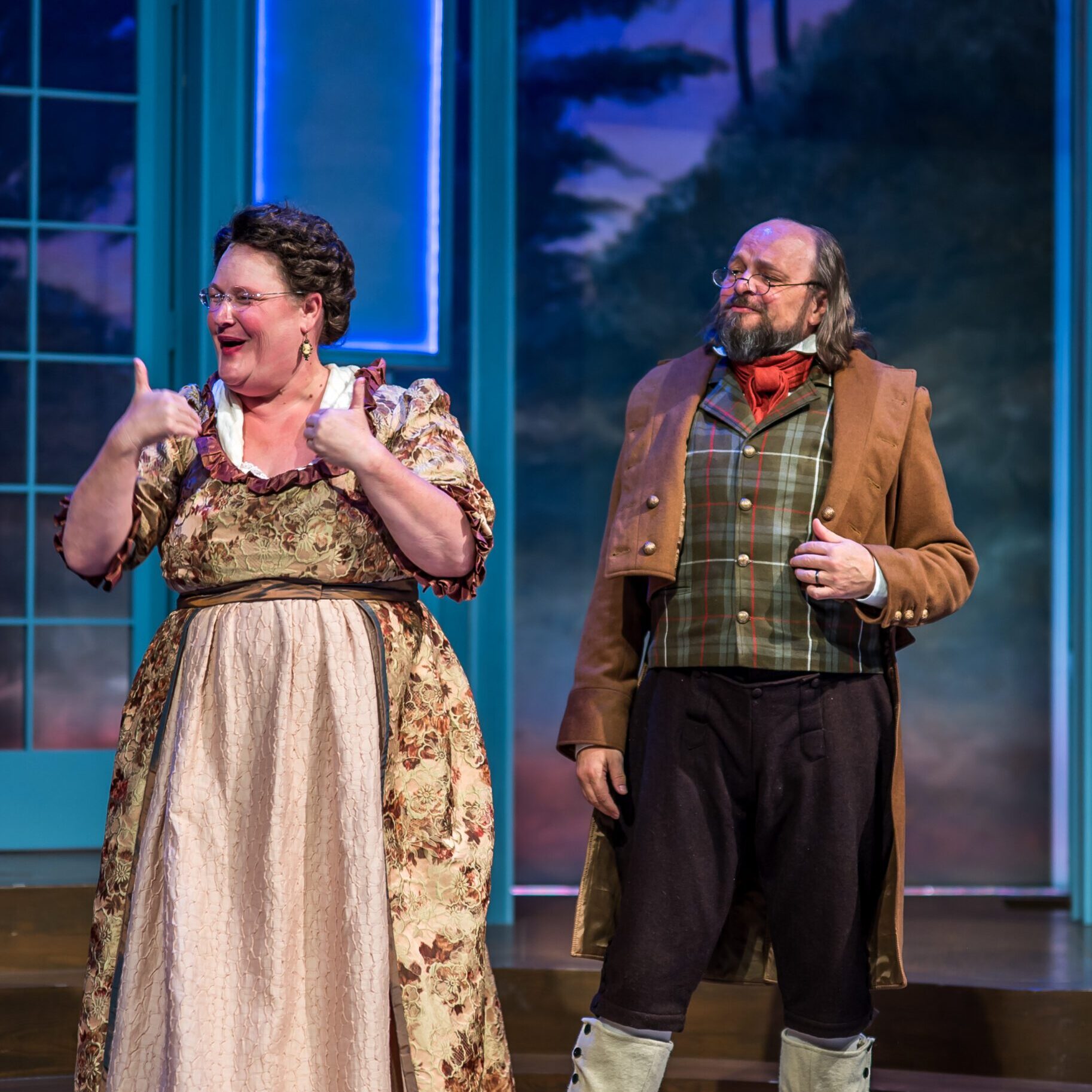
The use of American Sign Language for a central character is more than an inclusive choice; it directly mirrors the story’s central themes of miscommunication, social barriers, and human flaws. Fife’s expressive signing and nuanced mannerisms elevate Mrs. Bennet from a comedic punchline into a deeply caring mother acutely aware of the family’s practical realities and personal limitations. Because her daughters are interpreting through their own distinct personalities, Mrs. Bennet’s intentions are skewed. For example, when Sydney Claire Olsen as Lydia loudly interprets her mother’s signing, teenage immaturity shifts what is usually viewed as Mrs. Bennet’s social ignorance into a relatable 15-year-old’s obnoxious blunder.
I previously attended a production of Beauty and the Beast in ASL co-directed by Fife which incorporated ASL into the performance in meaningful ways. Similarly, this production with Fife’s performance seamlessly weaves sign language into the characters and narrative, offering a uniquely transformative understanding of the Bennet family dynamic.
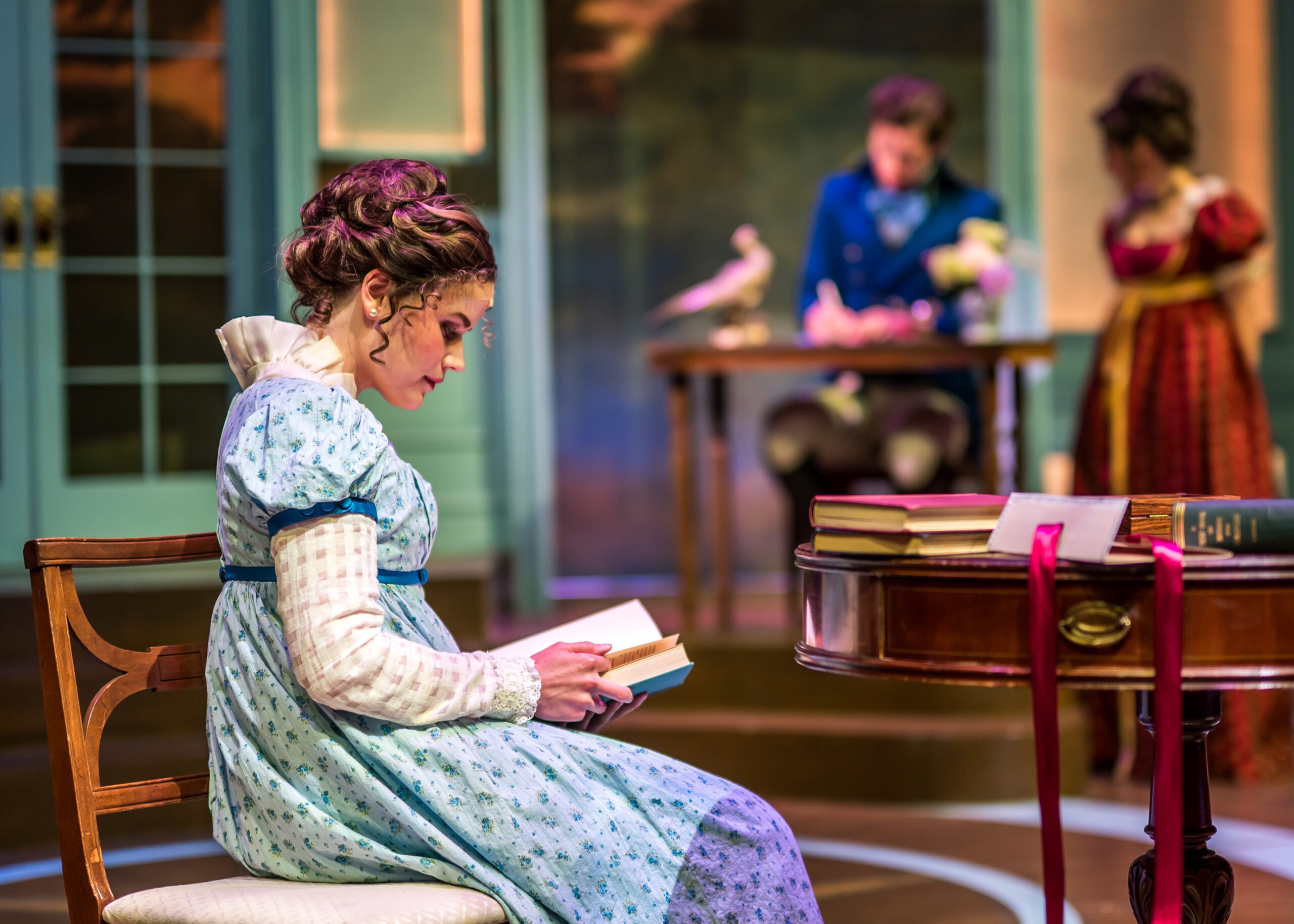
Lauren Pope as Elizabeth embodies the iconic heroine with delightful charm, intelligence, and sharp wit. Pope establishes Elizabeth’s complex nature early on showing a fierce devotion to her sister Jane, with immediate skepticism of Bingley and Caroline. Pope captures Elizabeth’s immediate infatuation of Wickham well and contrasts it nicely with a burning resolve against Darcy. Pope gives Elizabeth heart and laughter distinguishing herself on the stage as bright and attractive. Pope’s scenes at Rosing’s playing against DeLayne Bluth Dayton as Lady Catherine DeBourgh highlight Elizabeth’s confidence, especially as the scene is staged as an interrogation.
Opposite her, James Carter delivers a brilliant and deeply humanized performance as Mr. Darcy. As the tallest actor on stage, Carter’s physical height sets Darcy apart from the rest of the cast. His portrayal balances reticence, dignified confidence, and an undeniable intrigue toward Elizabeth. Carter shows Darcy’s growth as a character in performance. Two highlights are the sudden appearance of a smile after a conversation with Elizabeth at Pemberley, and a moving final interaction between Carter, as Darcy, and Fife, as Mrs. Bennet.
Pope and Carter play their roles with great chemistry and their scenes together are electric. Both proposals are staged well, with the second providing a lovely and romantic build to a swoon worthy stage kiss that closes the show.
Through Larson’s script adaptations, the production incorporates scenes outside of Elizabeth’s personal perspective—specifically conversations between Darcy, Bingley, and Caroline Bingley. These added, very natural, interactions with Isaac Gates as Bingley allow the audience to measure Darcy’s character and appreciate his underlying charm and principles long before Elizabeth comes to understand him.
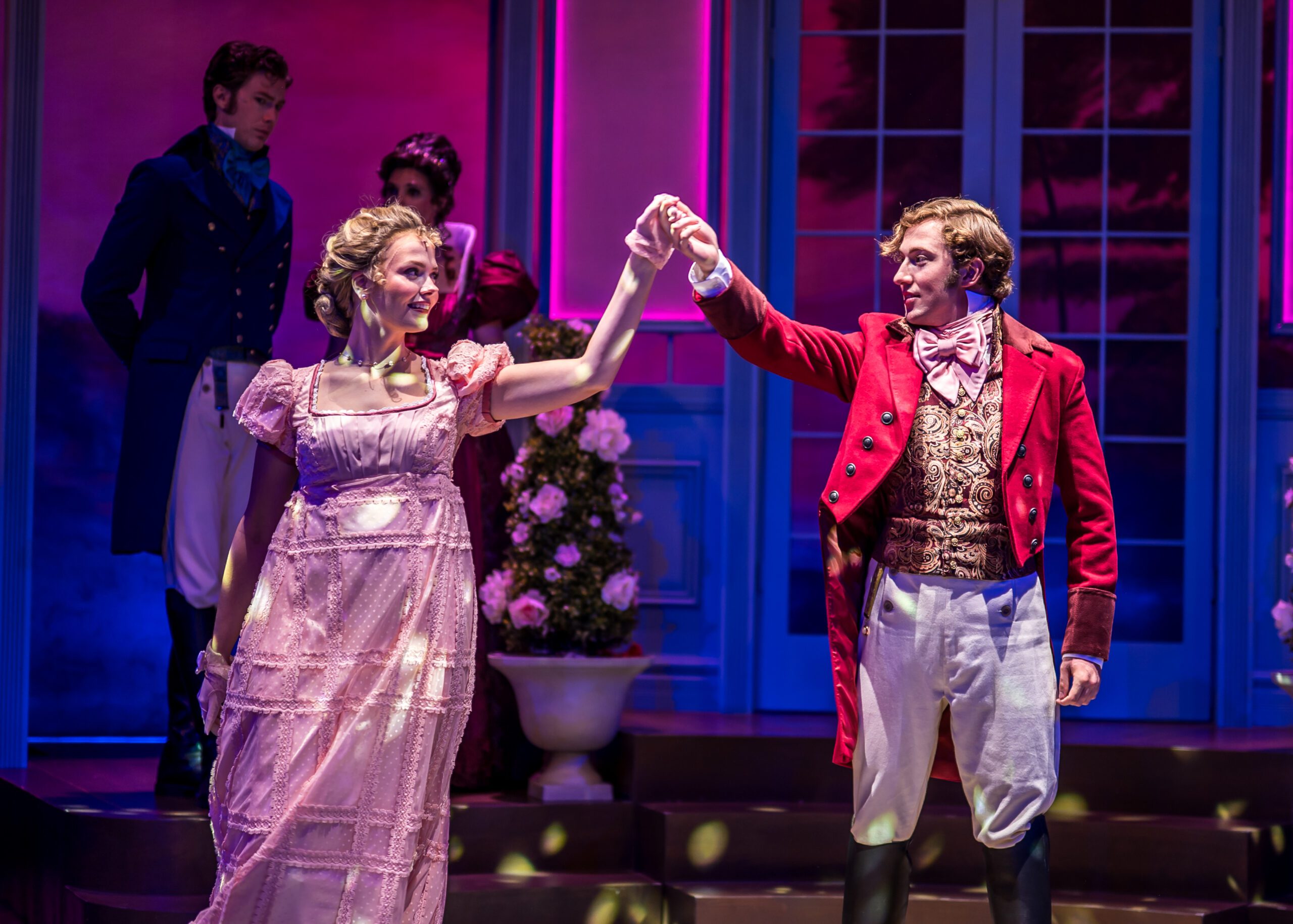
The surrounding cast elevates the production with equal skill. Gates plays Bingley’s clear infatuation evolving to heartsick love with Jane perfectly, and Jenna Anne Bagley as Jane is a wonderful match. Their heartache is shown particularly well in a dramatized letter writing scene. Anthony Tibolla as Mr. Collins provides superb comedic energy, while his scenes with Zoe Wilde as Charlotte Lucas offer a compelling, sensible rationale for their marriage. Their scenes underscore the director’s note that love and partnership encompass varied, and unexpected forms across a lifetime.
A standout feature of the direction is the continuous commitment of the entire ensemble. Regardless of where the main action is taking place, every actor on stage stays fully in character, creating a living, dynamic world. Dialects coached by Dianna Graham highlight class differences and avoid everyone sounding the same when they clearly inhabit different classes and status.
The staging and technical choices demonstrate remarkable attention to detail. Set transitions are handled with exceptional fluidity and creativity. For instance, during Elizabeth’s journey from Longbourn to Netherfield, she climbs across the changing set furniture to physically embody the exertion of her long walk.
Visual storytelling is enhanced through color associations especially by costume designer Brenda Van Der Wiel, with coordinated support by lighting designer Renee Fowler and set designer Jo Winiarski. Elizabeth and Darcy share matching shades of blue with Darcy’s blue growing more prominent as their connection deepens. Jane’s pink links to Bingley’s softer red attire and pink bowtie, while Lydia’s pink associates her with the red uniforms of the officers particularly Wickham. In contrast, Caroline Bingley and Netherfield pop in vivid deep reds, while Longbourn and the Bennet family inhabit humble beige and brown tones. Lady Catherine de Bourgh commands authority in regal purple, a color Charlotte Lucas wears in a paler shade. Evolving alongside the stage lighting with a crystal chandelier dropping for the more opulent households, these color schemes brilliantly mirror shifting allegiances, personal growth, and romance.
Hair and makeup design by Shannon Hutchins similarly reinforces character traits. Elizabeth’s makeup is kept natural compared to the heavier cosmetics applied to Jane and Lydia, while Mary’s look is minimal and Kitty’s falls in between. Regal characters like Caroline Bingley and Lady Catherine sport elaborate hair styling. In a subtle touch, Darcy’s structured hairstyle early in the play gradually softens to include loose pieces framing his face, mirroring Elizabeth’s softer aesthetic. Sound designer Richie Trimble includes accompaniment of contemporary melodies played by the Vitamin String Quartet to accentuate scenes so that every technical element works in harmony to deepen the narrative.
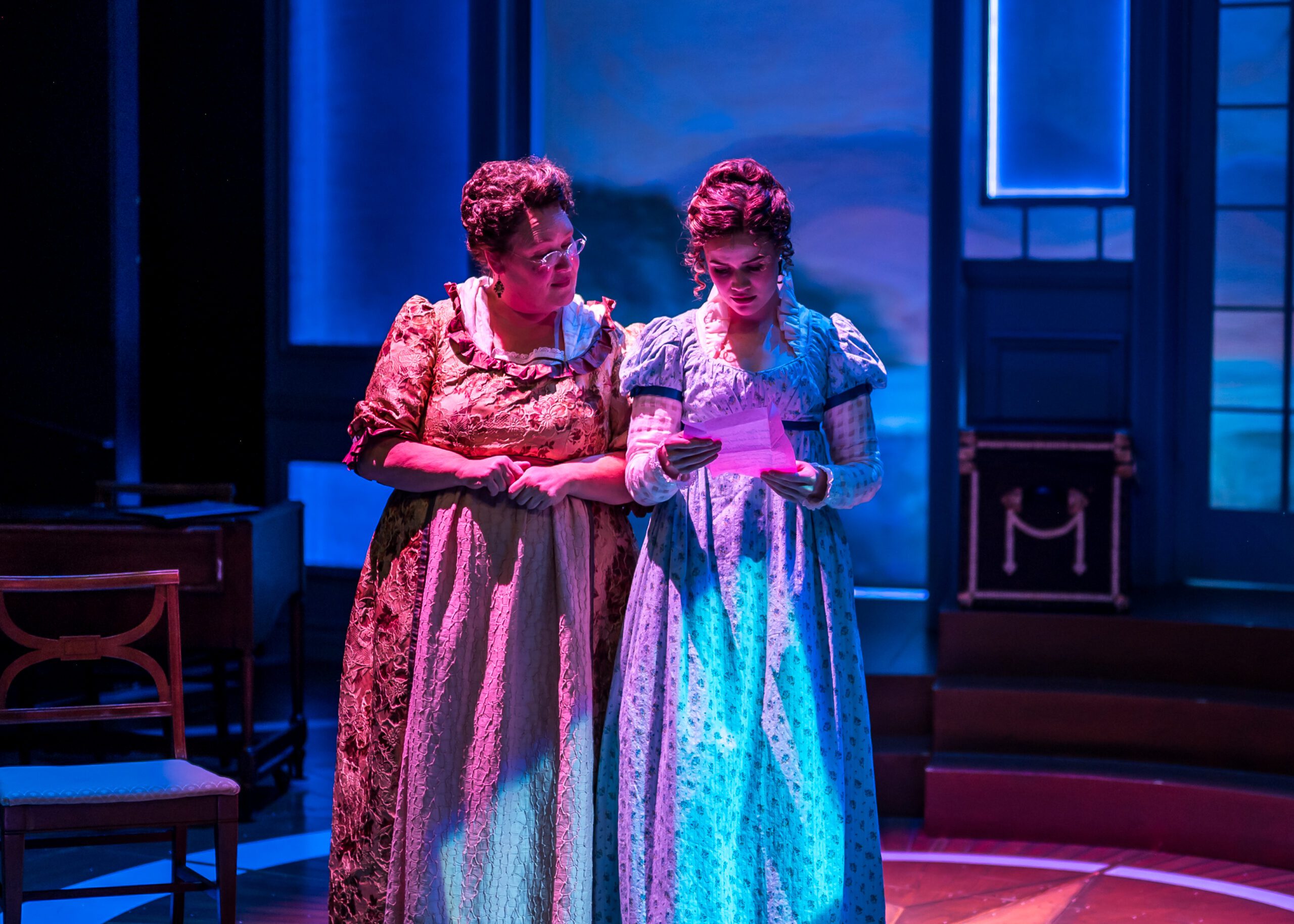
While the production is overwhelmingly successful, a few minor areas could be refined. The first act takes time building momentum, which may feel slow for some viewers before the narrative truly takes off. In contrast, the scenes at Pemberley feel somewhat rushed, using the letter writing device to summarize Elizabeth and Darcy’s encounters to Jane in a few brief moments before quickly transitioning to the crisis of Lydia and Wickham’s affair.
Nevertheless, these minor pacing notes do not diminish the excellence of the performance. I found myself in the middle completely enthralled and already writing a recommendation of admiring praise. Anyone of all ages interested in the characters, Austen, or regency romances will see something unique from previous iterations. It also demonstrates why newcomers find connection to Austen’s narratives as this production highlights capacity for human growth and extending grace to flawed characters. The heart and uniqueness of the Ruth’s Pride and Prejudice encourages theatergoers to set aside their own assumptions and see with fresh eyes and perspective.
Editors Note: Many roles are dual cast with alternating actors on Mon, Wed, Fri & Tues, Thurs, Sat. For those with alternating actors, the review covers those listed for the Saturday cast.
MORE INFO: Pride and Prejudice plays in the Lindsay Legacy Theater at the Ruth Theater in Pleasant Grove, (401 South Pleasant Grove Boulevard, Pleasant Grove, Utah 84062). Performances play through November 7th, 2027. Tickets range from $23-$69. More information can be found on The Ruth’s website here.
FOLLOW US ON FACEBOOK, INSTAGRAM, and TIKTOK!
If you’re a director, producer or marketing contact who would like to have us review your show, please fill out this form.
If you have comments about this article, please fill out this form.